Pavel Alekseyevich Belov
Павел Алексеевич Белов
1897 – 1962
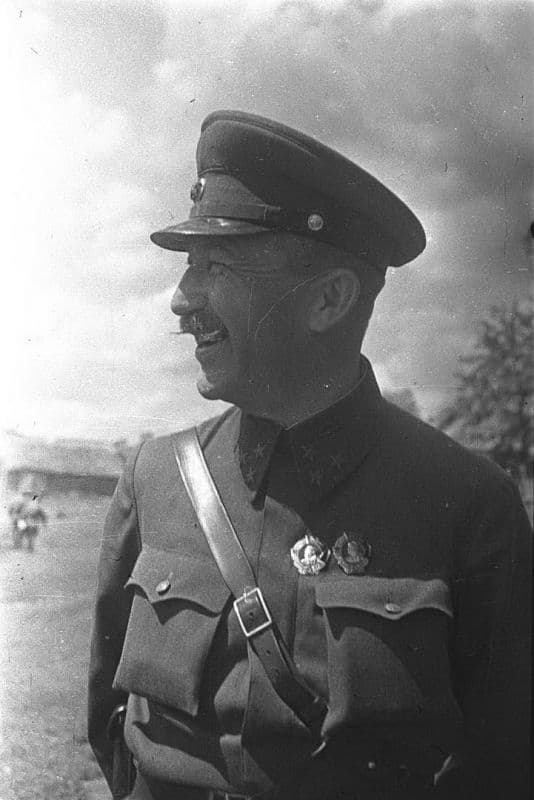
Pavel Alekseyevich Belov — Immediate source: lemur59.ru. Author given only as «Военные корреспонденты». Via Wikimedia Commons.
Virtual Candles
0 litBiography
Pavel Alekseyevich Belov was born on 6 (18) February 1897 in Shuya in Vladimir province, the son of a factory clerk. He worked as a timekeeper and then as a telegraphist at the station at Ivanovo-Voznesensk.
In May 1916 he was conscripted into the Imperial Russian Army and served as a private in a squadron of a reserve hussar regiment. In October 1917 he was sent to train and in January 1918 completed the 2nd Kyiv ensign school — but he never served as an officer: he left Kyiv, then in the middle of fighting, and went home.
He joined the Red Army in August 1918, at first as an instructor of the district universal military training office in Ivanovo-Voznesensk. From July 1919 he fought in the civil war as a cavalry platoon commander in the 21st Rifle Division, then held squadron and regimental posts, and from April 1922 commanded the 82nd Cavalry Regiment of the 14th Cavalry Division.
He completed the senior cavalry command course in 1927, served from 1929 on the staff of the Moscow Military District, from June 1931 as an officer for special assignments to Semyon Budyonny, a member of the USSR Revolutionary Military Council, and from December 1932 as assistant inspector of cavalry. He graduated from the Frunze academy in 1933. He commanded the 7th Cavalry Division, from July 1937 was chief of staff of the 5th Cavalry Corps, led that staff in the Soviet entry into western Ukraine in September 1939, and from October 1940 commanded the 96th Mountain Rifle Division.
In March 1941 he took command of the 2nd Cavalry Corps and went through the first months of the war with it on the Southern Front: the corps covered the 9th and 18th Armies, held the line of the Dniester and fell back fighting from Tiraspol to Kyiv. In the Kyiv operation, which ended in the destruction of the Soviet forces in Ukraine, he fought defensive actions on the Romny-Shtepovka axis and delivered a counter-blow there that allowed part of the encircled troops to be brought out. He received the Order of Lenin for the fighting of the summer and autumn of 1941.
From November 1941 he fought in the battle of Moscow, particularly in the Tula defensive operation. On 26 November 1941 his 2nd Cavalry Corps was the first formation in the Red Army to be given Guards status, becoming the 1st Guards Cavalry Corps — the same corps that Viktor Kirillovich Baranov, also in this archive, took over in July 1942. At Tula the "operational group of General Belov" was formed: besides his corps it included the 173rd and 415th Rifle Divisions, the 9th Tank Brigade, two separate tank battalions, the 15th Guards Katyusha mortar regiment and the army's junior lieutenant courses, with three more cavalry divisions added during the counter-offensive. The group halted the German advance on Moscow from the south near Kashira and then went over to the counter-attack.
After the Rzhev-Vyazma operation of 1942 the corps was encircled and fought for more than five months deep behind enemy lines.
The source also offers outside testimony: Franz Halder, chief of the general staff of the German army, mentions Belov repeatedly in his diaries for the first half of 1942 — according to this source more often than any other Soviet commander, and with a favourable assessment of his actions. The statement is given as the source gives it.
From June 1942 until the end of the war Belov commanded the 61st Army. Until the middle of 1943 its units fought south and south-west of Belyov, after which the army took part in the Oryol operation. His Hero of the Soviet Union was conferred for the battle of the Dnieper: between 26 September and 1 October 1943 the army's formations crossed the Dnieper at the village of Lyubech and seized a bridgehead on the right bank. The decree is dated 15 January 1944. The army went on to fight in the Gomel-Rechitsa, Kalinkovichi-Mozyr, Belorussian and Riga operations, in containing the Courland group, and in the Warsaw-Poznan, East Pomeranian and Berlin operations. He was promoted colonel general on 26 July 1944.
After the war he commanded the Don, North Caucasus and South Ural military districts, completed the higher academic course in 1949, and from 1955 to 1960 chaired the central committee of DOSAAF, the voluntary society for assistance to the armed forces. He retired on 30 September 1960. He was a deputy of the second to fifth Supreme Soviets of the USSR.
He died on 3 December 1962 in Moscow and was buried with military honours at Novodevichy cemetery.
Awards & Decorations
- Hero of the Soviet Union
- Order of Lenin
Community Contributions
Share what you know
If your family holds a photograph, a letter or a story, you can add it to this page. Everything you send is reviewed before it appears.
Same unit or organisation
Loading...
Comments
Sign in to leave a comment or tribute.
No comments yet. Be the first to share a memory.
Related Veterans
View all →
Butorin Viktor Vasilyevich
1898 – 1974
Guards Senior Sergeant
62nd Guards Cavalry Regiment, 16th Guards Chernigov Cavalry Division (formerly 112th Bashkir Cavalry Division), 7th Guards Cavalry Corps, 61st Army, Central Front
Baranov Viktor Kirillovich
1901 – 1970
Lieutenant General
1st Guards Cavalry Corps
Belfast
Levin Semyon Davydovich
1919 – 2003
Lieutenant Colonel
5th Guards Cavalry Corps