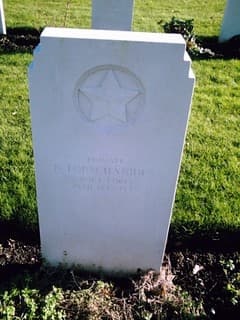
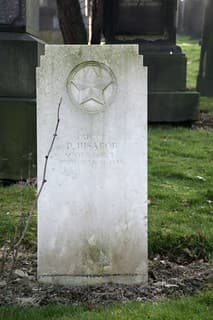
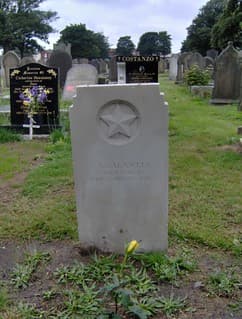
On 30 April 1942, a De Havilland Flamingo carrying four members of the Soviet Military Mission to Britain crashed near Great Ouseburn, Yorkshire. Among the dead was Hero of the Soviet Union Major Sergei Asimov, who had made the test flight for Molotov's historic Washington mission.
**The Memorial**
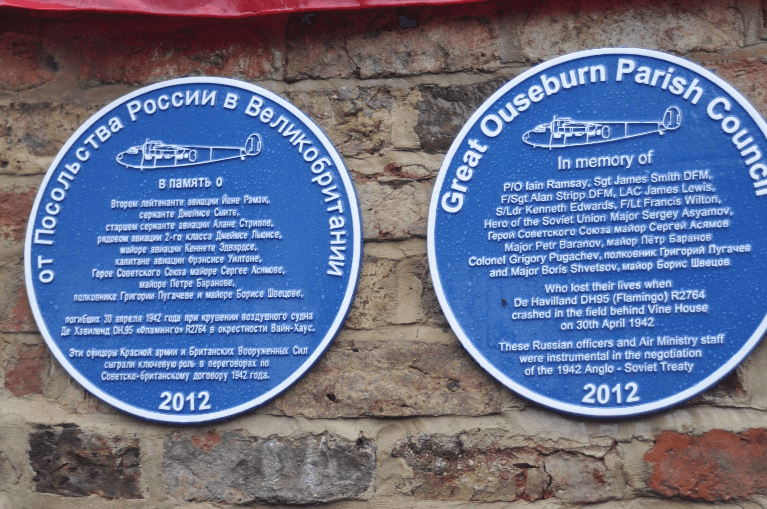
In 2012, commemorative plaques were unveiled on the main street of Great Ouseburn, North Yorkshire (Main Street, Great Ouseburn, WMWC06), to honour four Soviet officers who died in an aircraft crash nearby on 30 April 1942:
- **Major Sergei Alexandrovich Asimov** (1907–1942), Hero of the Soviet Union, bomber commander
- **Colonel Grigory Petrovich Pugachev**, deputy head of the Soviet Military Mission for aviation matters
- **Major Boris Filippovich Shvetsov**, assistant military attaché
- **Military Engineer 2nd Class Petr Ivanovich Baranov**, mission secretary
The ceremony was organised by the Russian Embassy in London and the municipality of Great Ouseburn, with the plaques unveiled to the sound of the "Aviators' March."
**The Story**
In spring 1942, Stalin needed to open the Second Front. Soviet Foreign Minister Molotov was to fly to Britain and the United States for negotiations. Long-range aviation commander General Golovanov was ordered to plan the route: Moscow–Riga–Dundee–Reykjavik–Washington — daring and dangerous, over German-occupied Europe.
Before Molotov's flight, a TB-7 bomber crew under Major Asimov made a test flight from Moscow to Dundee (Tealing airfield) to verify the route's feasibility. The flight succeeded, but the next day Asimov was selected by lot to give British pilots a tour of the aircraft. On 30 April 1942, travelling back to London in De Havilland Flamingo D.H.95, the right engine exploded over Yorkshire near Great Ouseburn. The aircraft fell from 600 metres; all on board — including four RAF crew and six passengers — perished. The aircraft wreckage was scattered over nearly 5 km.
The Soviet-British commission found: *"The cause of the crash was an internal engine defect, its destruction and subsequent explosion of fuel vapour, leading to wing collapse."*
Major Asimov had participated in the first Soviet bombing raid on Berlin on 10 August 1941 and had completed 48 combat sorties. He was posthumously awarded the title Hero of the Soviet Union by decree of 20 June 1942. Stalin reportedly remarked after the crash: *"What allies we have!"* — suggesting suspicion of German intelligence or pro-German circles, though engine failure remains the most likely cause.
Negotiations with Molotov were ultimately successful. The Second Front opened on 6 June 1944 with Operation Overlord.
*Research by Roman Firsov, independent historian. r.firsov@gmail.com | www.group9may.com*
Preserve a memory
Do you have a veteran in your family? Add their story to the Immortal Regiment registry.