Pavel Ivanovich Batov
Павел Иванович Батов
1897 – 1985
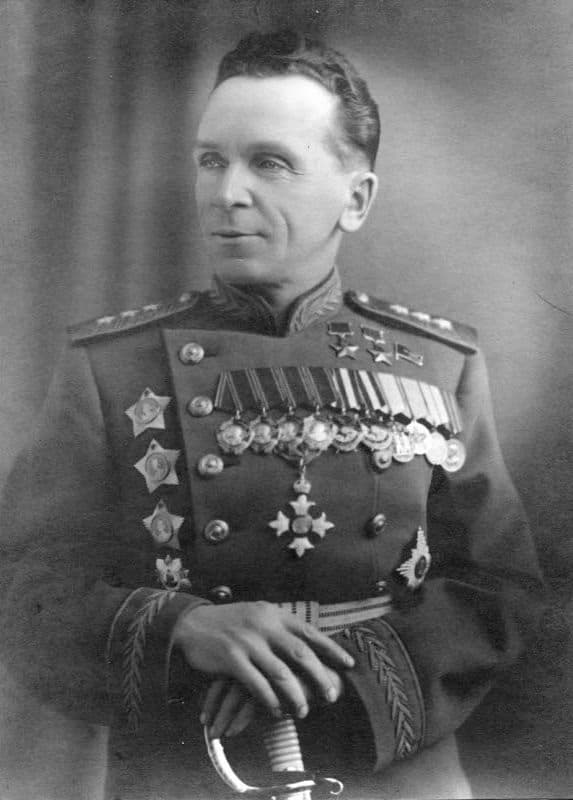
Pavel Ivanovich Batov — Source: Ministry of Defence of the Russian Federation, encyclopedia.mil.ru. Licensed CC BY 4.0 (Mil.ru).
Virtual Candles
0 litBiography
Pavel Ivanovich Batov was born on 20 May (1 June) 1897 in the village of Felisovo in Rybinsk uyezd of Yaroslavl province, into a poor peasant family. He finished the two-class village school and from the age of thirteen lived in St Petersburg, working for the Leonov brothers' trading house and then as a loader and delivery boy to the flats of well-off townspeople. He taught himself and passed the six-year school examinations externally.
In November 1915, on turning eighteen, he volunteered for the Imperial Russian Army and joined the Life Guards 3rd Rifle Regiment, where he completed the training detachment. From 1916 he fought on the Northern Front as commander of a scout section, was awarded two Crosses of St George and two medals, and in the autumn of 1916 was wounded and sent to Petrograd for treatment. In 1917 he completed the preparation for the 2nd Peterhof ensign school but was demobilised as a junior non-commissioned officer before receiving an officer's commission.
He was called into the Red Army in August 1918. During the civil war he served as assistant commander of a machine-gun platoon and then in staff and command posts at Rybinsk and in the Moscow Military District, and took part in suppressing anti-Soviet risings and mutinies at Rybinsk, Yaroslavl and Poshekhonye. From May 1920 he commanded a company and then a battalion of the 320th Rifle Regiment in the Moscow Proletarian Rifle Division.
Between the wars he commanded battalions and regiments, completed the Vystrel course in 1927, became chief of staff of the 52nd Rifle Regiment in 1931 and in 1934 commander of the 3rd Rifle Regiment of the Moscow Proletarian Division. Among those serving under him then was Gleb Baklanov, later a colonel general and Hero of the Soviet Union — he is in this archive — who wrote in his memoirs that it was Batov, by drawing him into staff work, who settled his choice of the professional officer's career.
From December 1936 to August 1937 Batov served in Spain under the pseudonym Pablo Fritz, as military adviser to the 12th International Brigade under Máté Zalka and then as adviser to the commander of the Teruel front. He was severely wounded — by his own account during a reconnaissance, losing a great deal of blood. On his return he received the Orders of Lenin and of the Red Banner and was appointed to command the 10th and then the 3rd Rifle Corps; he took part in the Red Army's entry into Poland in September 1939 and in the Soviet-Finnish war. From March 1940 he commanded the Special Rifle Corps, from April was deputy commander of the Transcaucasian Military District, from November 1940 commander of the 9th Special Rifle Corps in the Crimea, and from 20 June 1941 also commander of the ground forces in the Crimea.
When the war began he organised the Crimea's defence against landings. On 14 August 1941 the 51st Separate Army was formed on the basis of his corps, with Fyodor Kuznetsov commanding and Batov as his deputy; in the second half of September he led an operational group for counter-attacks and directed the troops repelling German attempts to break into the Crimea through the Perekop isthmus. From 19 November to December 1941 he commanded the 51st Separate Army and prepared it for the Kerch-Feodosiya landing operation.
At the end of December 1941, after the death of Pyotr Pshennikov, he took over the 3rd Army of the Bryansk Front. In January and February 1942, on the orders of the front commander Yakov Cherevichenko, the army mounted a series of offensives which failed with heavy losses. Batov wrote of that period in his memoirs: "A soldier's duty is to carry out the order. But in this case the sense of duty compelled me to protest. Our relations with Cherevichenko became strained." In February 1942 he was relieved of the army command and appointed assistant to the front commander for formations. The task was thankless and concrete: to comb the rear areas for men — several thousand were found in the rear services of the front, the armies and the divisions and sent to fighting units without damaging the services they came from.
In the autumn of 1942, at Konstantin Rokossovsky's request, Batov was appointed to command the 4th Tank Army of the Don Front, taking command on 14 October; on 22 October the army was redesignated the 65th, which he commanded until the end of the war. Preparing the offensive, he insisted that every commander understood his own task and how to work with his neighbours, and introduced the practice of rehearsing the details of an operation on a sand table — a model of the ground with the tactical situation marked on it.
On 19 November 1942 the army attacked from the Kletskaya bridgehead and by the end of the day had advanced 5 to 8 kilometres without fully breaking the first defensive belt. Batov gathered every tank the army had, with some infantry sub-units on vehicles, into a mobile strike group, and within the first day it drove 23 kilometres into the defences. Feeling the threat of envelopment, the enemy slackened his resistance, and from 24 to 27 November the army advanced a further 25 to 40 kilometres to reach the Don, taking Vertyachy in the fighting of 28 to 30 November. In January 1943 the 65th Army took part in destroying the encircled force.
In the spring of 1943, by then on the Central Front, the army carried out the Sevsk operation, advancing 30 to 60 kilometres, and in the battle of Kursk held the salient near Sevsk. From 26 August to 30 September 1943, in the Chernigov-Pripyat operation, it broke the defences at Sevsk, crossed the Desna, liberated Novgorod-Seversky and fought its way some 300 kilometres in a month, reaching the middle Dnieper at Loyew.
On 15 October 1943, after a heavy artillery preparation, four battalions seized a bridgehead on the right bank of the Dnieper by ten in the morning and held it all day; that night the army's formations crossed by the bridges that had been laid, and by 27 October the bridgehead was 35 kilometres wide and 20 deep. For this Batov was made a Hero of the Soviet Union on 30 October 1943.
The army lost heavily in men and commanders in the battle of the Dnieper. The decision Batov took then is worth recording: he sent a hundred of his best Heroes of the Soviet Union to the army's junior lieutenant courses, to replace the officers who had been lost.
The 65th Army went on to fight in the Kalinkovichi-Mozyr operation, in Operation Bagration, and in the Vistula-Oder, Mlawa-Elbing, East Prussian, East Pomeranian and Berlin operations. The last salvo fired in the army's sector was by Katyushas against the garrison on the island of Rügen. Colonel General Batov received his second Gold Star on 2 June 1945, for his command of troops in the Belorussian operation, in the crossing of the Vistula, in the storming of Danzig and in the taking of Stettin.
After the war he commanded the 7th Mechanised Army and the 7th Separate Tank Division, from 1950 the 11th Guards Army, and from 1954 was first deputy commander-in-chief of the Group of Soviet Forces in Germany, then commanded the Carpathian and Baltic military districts. He was made a General of the Army on 10 March 1955. From November 1959 he was senior military adviser to the Chinese People's Liberation Army, from August 1961 commander of the Southern Group of Forces, and from September 1962 first deputy chief of the General Staff and chief of staff of the Warsaw Treaty joint forces. From 1970 he chaired the Soviet War Veterans' Committee. He was a deputy of the first, second and fourth to sixth Supreme Soviets of the USSR.
He died on 19 April 1985 in Moscow and is buried at Novodevichy cemetery. His second wife, Nina Fyodorovna Batova, was herself a participant in the battle of Stalingrad.
Awards & Decorations
- Hero of the Soviet Union (twice)
- Order of Lenin
- Order of the Red Banner
- Cross of St George (x2)
Community Contributions
Share what you know
If your family holds a photograph, a letter or a story, you can add it to this page. Everything you send is reviewed before it appears.
Same unit or organisation
Loading...
Comments
Sign in to leave a comment or tribute.
No comments yet. Be the first to share a memory.
Related Veterans
View all →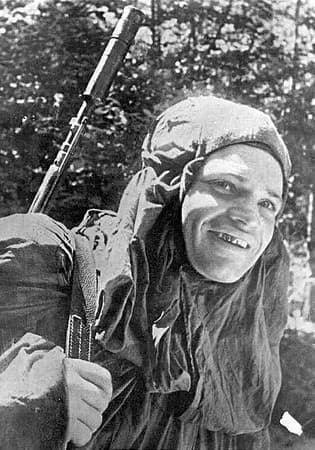
Butkevich Leonid Vladimirovich
1918 – 1985
Lieutenant
1331st Rifle Regiment, 318th Rifle Division, 18th Army, North Caucasus Front
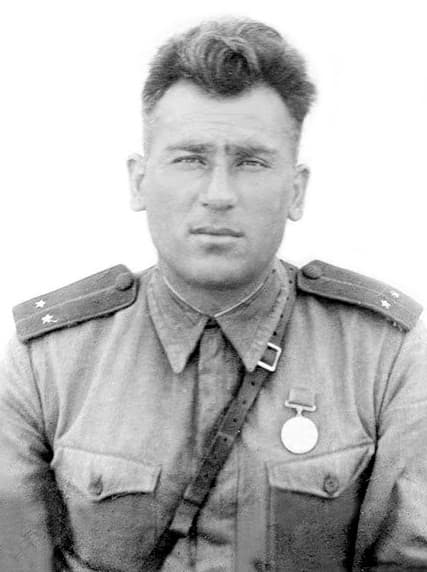
Butayev Georgy Danilovich
1910 – 1943
Lieutenant
712th Rifle Regiment, 132nd Rifle Division, 60th Army, Central Front
Bushmakin Aleksey Petrovich
1913 – 1964
Guards Major
16th Guards Mechanised Brigade, 6th Guards Mechanised Corps, 4th Tank Army, 1st Ukrainian Front
Butsky Iosif Ivanovich
1919 – 1980
Major
515th Rifle Regiment, 134th Rifle Division, 69th Army, 1st Belorussian Front