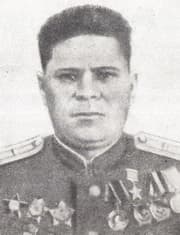
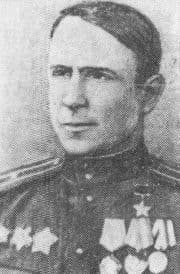
Biography
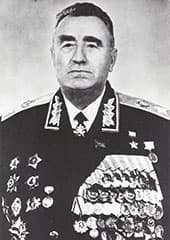
Pavel Fyodorovich Batitsky was born on 14 (27) June 1910 in Kharkiv into a working family. He was Ukrainian. He completed four years of junior secondary school in 1922 and then the factory apprentice school at the Kharkiv Serp i Molot engine works.
In October 1924, aged fourteen, he was enrolled in the Ukrainian military preparatory school in Kharkiv, later moved to Poltava. From there he went to the 2nd Borisoglebsk-Leningrad cavalry school, and from September 1929 served in the 40th Cavalry Regiment of the 7th Samara Cavalry Division as commander of a cavalry and then a sapper platoon, and from December 1931 as assistant commander and commander of the regiment's independent sapper squadron. He studied at the Frunze academy from 1935 to 1938, graduated with distinction and was appointed an officer for special assignments in the operations department of the General Staff. In September 1939 he was sent to China as chief of staff of the group of Soviet military advisers at Chiang Kai-shek's headquarters; returning in December 1940, he became chief of staff of the 11th Motorised Machine-Gun and Artillery Brigade at Kaunas, and from March 1941 chief of staff of the 202nd Motorised Division.
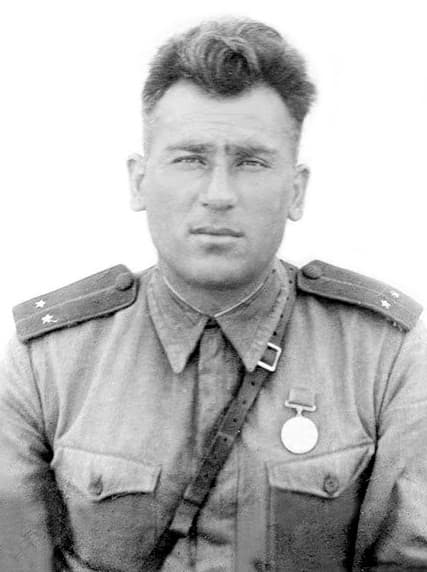
Lieutenant Colonel Batitsky held that post when the war began. The division fought hard defensive actions on the North-Western Front and took part in the front's counter-attack towards Siauliai on 23-25 June 1941, losing its equipment in the process, after which it fell back towards Pskov. In August Batitsky came out of encirclement towards Novgorod with a few men.
From September 1941 he was chief of staff of the 26th Rifle Division and from November commander of the 254th Rifle Division. The division fought in the Demyansk operation and held the northern flank of the "Ramushevo corridor", preventing the enemy from widening it; its repeated attempts to cut the supply of the encircled 2nd Army Corps did not succeed. This record says so directly: the holding worked, the cutting did not.
From 20 July 1943 he commanded the 73rd Rifle Corps. The corps fought in the battle of the Dnieper and crossed the river twice — in September 1943 south of Kanev and, after redeployment, in November and December near Cherkasy, which it then helped to liberate. The Korsun-Shevchenkovsky and Uman-Botosani operations followed, with the liberation of Zenkov, Uman and Balti. On 26 March 1944, having crossed the Prut north of Ungheni, the corps was among the first to reach the state border with Romania.
At a conference attended by Ivan Konev, Batitsky argued that attacking with weakened forces was inadvisable — and was removed from command of the corps for it. The episode is here because it belongs to the substance of his service, not only to its successes.
On 24 April 1944 he took over the 50th Rifle Corps and at the end of May the 128th Rifle Corps, with which he fought in the Belorussian operation: after the breakthrough south of Bobruisk, in the liberation of Baranovichi and Brest and in the crossing of the Western Bug. The corps was then moved to East Prussia for the Gumbinnen-Goldap and East Prussian operations, and in March and April 1945 was transferred to the 1st Ukrainian Front for the Berlin and Prague operations.
He was recommended for the Hero of the Soviet Union in December 1943 for the liberation of Cherkasy, and was not awarded it then. The title came more than twenty years later: by decree of the Presidium of the Supreme Soviet of 7 May 1965, General of the Army Batitsky was made a Hero of the Soviet Union with the Order of Lenin and Gold Star no. 10681, for skilful command of troops and for the courage and heroism shown in the struggle against the German invaders, and to mark the twentieth anniversary of the victory. The decree therefore names both his war record and the anniversary.
After the war he graduated with a gold medal from the Voroshilov higher military academy in 1948, commanded the 73rd Rifle Corps, and was then transferred to the Air Defence Forces as chief of staff and first deputy commander of the Moscow air defence district. In February 1950 he took command of the Shanghai air defence group in China, covering Chinese territory against Kuomintang air raids from Taiwan; after the Kuomintang lost six aircraft to anti-aircraft fire and one in air combat, the raids stopped. One aircraft of the Chinese People's Liberation Army air force was shot down in error; the group suffered no air combat losses of its own.
From September 1950 he was chief of the main staff and deputy commander-in-chief of the air force. On 26 June 1953, together with Kirill Moskalenko, commander of the Moscow air defence district, and under Georgy Zhukov, he took part in arresting Lavrentiy Beria at a session of the Presidium of the Council of Ministers and in removing him secretly from the Kremlin. On 23 December 1953, after sentence was passed by the Special Judicial Presence of the Supreme Court, Batitsky personally carried out the death sentence; this is recorded in the execution act of 23 December 1953, signed by him, Roman Rudenko and Moskalenko. The fact is stated as documented, without comment.
In May 1954 he was appointed to command the 7th Mechanised Army, in August of that year the Moscow air defence district, and in March 1965 first deputy chief of the General Staff. From July 1966 he was commander-in-chief of the country's Air Defence Forces and a deputy minister of defence, and at the same time commander of the air defence forces of the Warsaw Treaty joint forces. In 1970 he took part in Operation Kavkaz, Soviet military assistance to Egypt during the War of Attrition. He was made a Marshal of the Soviet Union on 15 April 1968.
In July 1978 he was released from his post on his own written request, submitted because he disagreed with transferring much of the Air Defence Forces to the border military districts: he was unwilling, in his words, to take part in "an experiment that undermines the defence capability of the state". The words are given as the source gives them. He then served as an inspector general in the defence ministry's group of inspectors general.
He died on 17 February 1984 in Moscow and is buried at Novodevichy cemetery.