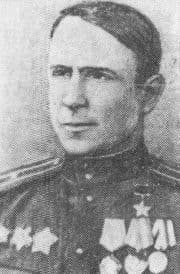
Biography
Gleb Vladimirovich Baklanov was born on 1 (14) August 1910 in Moscow into a prosperous merchant family. His grandfather, Nikolai Kozmich Baklanov, was a first-guild merchant and part-owner of a trading house; his father owned the Kupavna textile factory; his mother, formerly a stage actress, left the theatre to raise six children. His elder sister Olga Baklanova did not return to the USSR from a tour of the United States in 1926 and became a well-known actress there; another sister, Nataliya, was a violinist. He finished secondary school and the Moscow polytechnic college, took up gymnastics and became champion of Moscow.
He was conscripted into the Red Army in November 1932 and served in the 1st Moscow Proletarian Rifle Division as platoon commander, assistant company commander, battalion chief of staff, head of the regiment's chemical defence and assistant chief of staff. He was discharged to the reserve in July 1938 and recalled in May 1939 as chief of staff of the 541st Rifle Regiment. He fought in the Soviet-Finnish war, was wounded and received the Order of the Red Banner. After his first year at the Frunze academy he became chief of staff of the 6th Motor Rifle Regiment in December 1940.
He held that post when the war began, and from August 1941 commanded a battalion of the 175th Motor Rifle Regiment, fighting in the frontier battle and at Smolensk. He was severely wounded near Orsha and was recommended for discharge as disabled. Instead, in November 1941, he was given a cadet battalion at the Omsk infantry school, and in January 1942 the 157th Rifle Brigade, which soon fought near Staraya Russa.
From June 1942 he commanded the 299th Rifle Division at Stalingrad, and for that fighting received the Order of Alexander Nevsky and the American Distinguished Service Cross. From May 1943 he commanded the 13th Guards Rifle Division: Kursk, the battle of the Dnieper, the liberation of Poltava and Kremenchug, and then the Lower Dnieper, Kirovograd, Uman-Botosani and Lvov-Sandomierz operations.
In October 1944 he took over the 34th Guards Rifle Corps. The corps fought in the Vistula-Oder, Lower Silesian and Upper Silesian operations and in the encirclement of a fifty-thousand-strong enemy force at Breslau. From April 1945 it took part in the Berlin and Prague operations, crossed the Spree and the Elbe and liberated Dresden on 8 May, for which it received the honorific "Dresden".
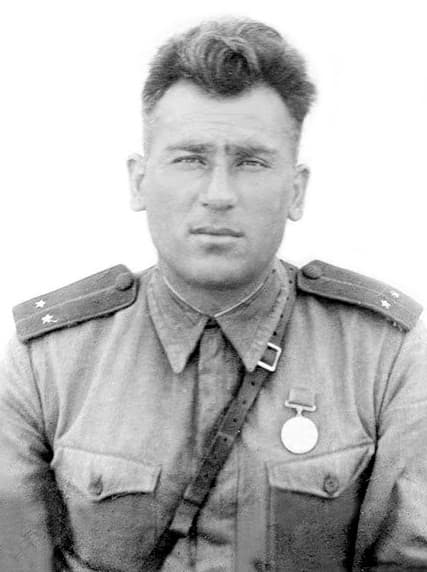
By decree of the Presidium of the Supreme Soviet of 29 May 1945, Major General Gleb Vladimirovich Baklanov was made a Hero of the Soviet Union with the Order of Lenin and Gold Star no. 6564. The decree uses the general formula about excellent performance of combat tasks; it names no single episode, and the basis is his command of the corps in the operations set out above. At the Victory Parade of 1945 Baklanov commanded the composite regiment of the 1st Ukrainian Front.
After the war he commanded the 34th and 20th Guards Rifle Corps. In June 1948, having completed the higher academic course, he was appointed head of physical training and sport for the Ground Forces; he was among the leaders of the Soviet delegation that went to London to assess whether the USSR would take part in the Olympic Games, and that year was elected chairman of the all-union gymnastics section. From April 1954 he commanded the 13th Army, from February 1959 was first deputy commander of the Northern Group of Forces, from May 1960 commanded the Siberian Military District and from November 1964 the Northern Group of Forces. He was a deputy of the sixth and seventh Supreme Soviets of the USSR.
Colonel General Baklanov retired in June 1967 and went on working in sport. The source gives the years of his chairmanship of the gymnastics federation differently in two places: 1948-50 and 1972-75 in one, 1967-75 in the other; the discrepancy is reproduced as it stands. He wrote two volumes of memoirs, A Point of Support (1971) and The Wind of the War Years (1977). His son Andrei Baklanov is a diplomat who served as Russian ambassador to Saudi Arabia from 2000 to 2005.
He died on 16 January 1976 in Moscow and is buried at Novodevichy cemetery.