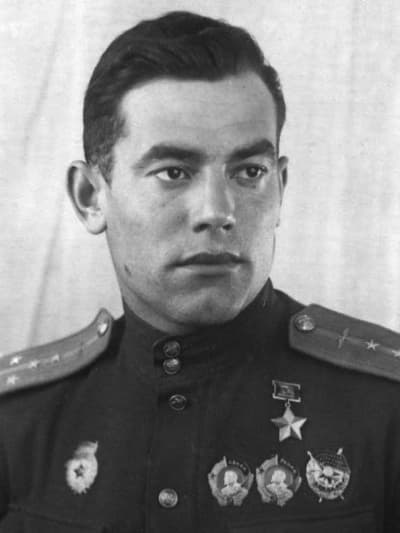
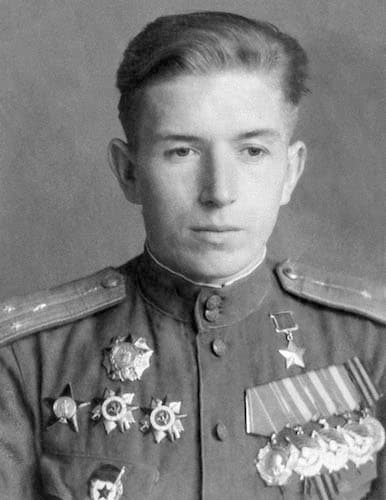
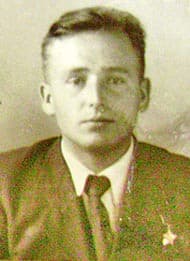
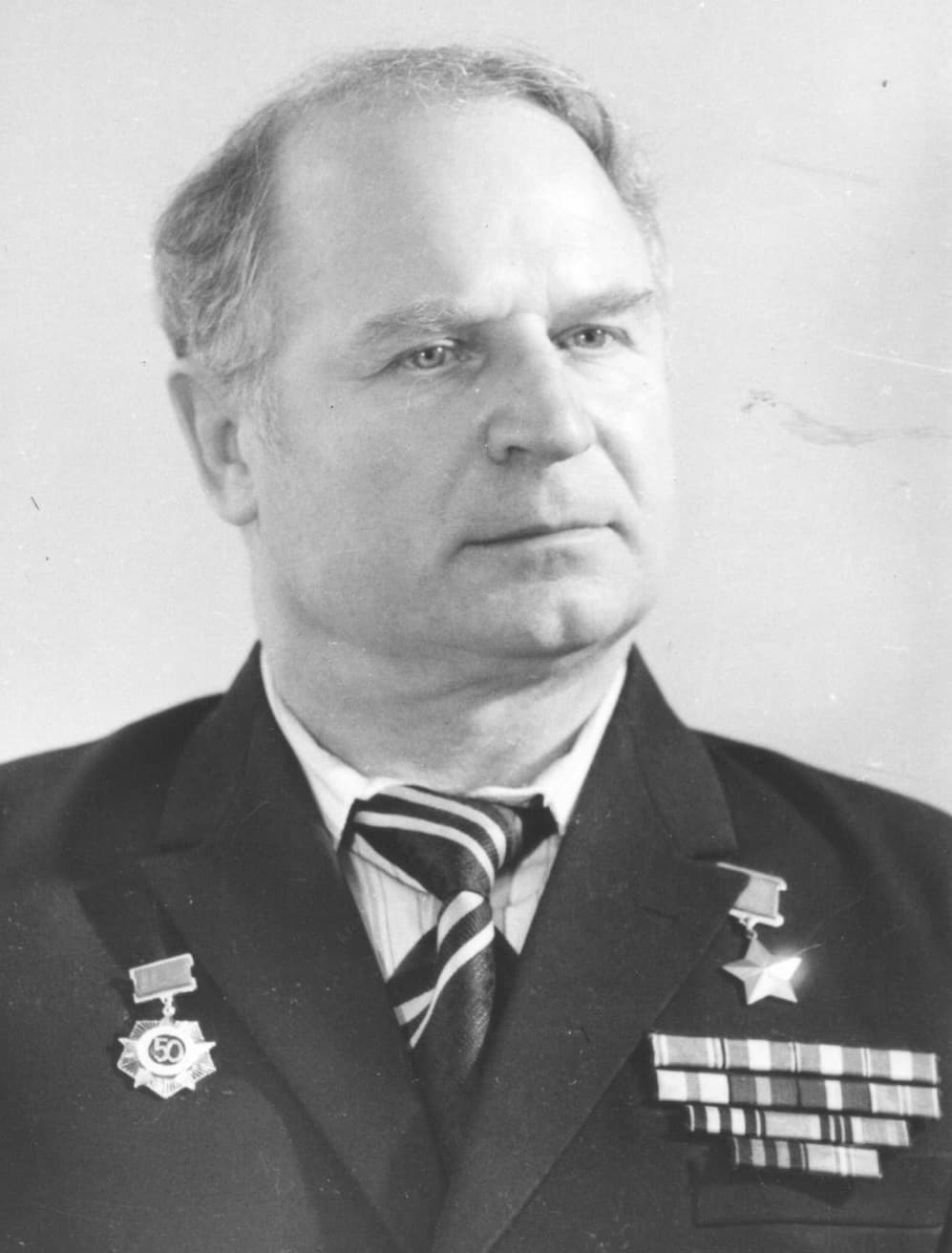
Andrey Yakovlevich Baklan, 1943 — Soviet photograph, 1943. Author unknown. Via Wikimedia Commons. Public domain (PD-Russia-1996); original publication the magazine «Огонёк» no. 23-24, 1943; immediate source waralbum.ru.
Biography
Andrey Yakovlevich Baklan was born on 10 (23) July 1917 in the village of Kalinovka, now in Vitovsky district of Mykolaiv region, into a peasant family. He was Ukrainian, the youngest of eight children; his brothers were killed in the fighting against Petliura's forces. During the famine years he left for Mykolaiv at fourteen, entered the factory apprentice school at the shipyard and afterwards worked as a marker in one of its shops. Alongside the work he joined a parachute club and then a flying club, graduating from it in 1936.
He was in the Red Army from 1938 and graduated from the Odessa military aviation school for pilots the same year.
He fought in the Soviet-Finnish war. Lieutenant Baklan went with the 49th Fighter Aviation Regiment to the Karelian Isthmus, where he flew about forty sorties strafing troops and escorting bombers, and was awarded the Order of the Red Banner; the regiment received the same award. In the summer of 1940 the regiment moved to Dvinsk, now Daugavpils, and that winter Baklan took the flight commanders' course in Riga, where he gained experience of flying at night and in poor weather.
He met the war on the western border. On 23 June 1941 he was nearly killed when Me-110s raided his airfield. In under a month of fighting the regiment lost all its aircraft and half its personnel and was withdrawn to re-form; having converted to the Yak-1, the pilots returned to escort and reconnaissance work. In July 1941, strafing the airfield at Novgorod-Seversky, Baklan shot down his first Messerschmitt as it took off; in August over Bakhmach he destroyed an Hs-126 spotter whose pilot parachuted out and was taken prisoner. By February 1942, when he was transferred to the 521st Fighter Aviation Regiment and Ivan Kleshchev's squadron, he had six victories.
In March 1942 a flight of three fighters - Baklan, Semyon Selishchev and Vladimir Alkidov - returning from a mission, attacked a large group of Ju-87 dive-bombers approaching Soviet positions. Five aircraft were shot down, two of them by Baklan, and the dive-bombers turned west. The air army commander, Mikhail Gromov, presented the pilots with Orders of Lenin. The same source elsewhere describes the action as a victory by the flight over eighteen bombers and nine fighters; that is a different claim, and it is set out here separately rather than merged with the first.
In the summer of 1942 Baklan was transferred to the 434th Fighter Aviation Regiment, whose pilots distinguished themselves at Stalingrad. On his twenty-fifth birthday he shot down a Me-109, was attacked by three more and wounded in the arm; he broke away so low that one of the Messerschmitts struck the ground and blew up. In early September 1942 the regiment converted to the Yak-7B, and on his first sortie in the new aircraft Baklan shot down an Italian Macchi 200 fighter. By October 1942 he had flown 400 combat sorties, 57 of them against troops and columns on the ground.
By decree of the Presidium of the Supreme Soviet of 23 November 1942, Senior Lieutenant Andrey Yakovlevich Baklan was made a Hero of the Soviet Union with the Order of Lenin and Gold Star no. 755. The decree uses the general formula; the basis is the record of operations set out above.
In March 1943 he took part in an action over the river Lovat in which four fighters led by Captain Ivan Kholodov engaged sixteen German aircraft and two ramming attacks were made: Kholodov rammed a Me-109 that was attacking his wingman, and Lieutenant N. Koval, Baklan's own wingman, rammed and brought down an FW-190.
By the summer of 1943 Baklan had moved to the 19th Red Banner Fighter Aviation Regiment as regimental navigator and then commanded its 3rd squadron. Flying the La-5FN he shot down two Me-109s in April 1944, and after the regiment re-equipped with the La-7 he brought down an FW-190 on 24 June 1944. In July 1944 he flew 17 sorties and four air battles, shot down three enemy fighters and received the Order of Suvorov 3rd Class.
In the autumn of 1944 the squadron of Guards Major Baklan, reinforced by the pair of Ivan Kozhedub and Dmitry Titarenko, was sent against a group of German aces operating in the sector of the 3rd Baltic Front. Between 20 September and 12 October the group shot down twelve enemy fighters; one of Baklan's came on 23 September, an FW-190. The source names the German group's commander as a Major Wilcke and credits him with 130 victories; that is the source's statement and has not been independently verified here.
In 1945 Baklan was ordered to Moscow and then to the Far East, where as a squadron commander he escorted bombers and covered the tank columns crossing the Khingan range in the war against Japan. Over the war he flew more than 700 combat sorties and shot down 20 aircraft alone and 21 shared, flying the I-153, Yak-1, Yak-7, La-5 and La-7.
After the war he commanded a regiment, graduated from the air force academy in 1952 and flew the MiG-15 and MiG-17. From June 1952 he commanded the 851st training aviation regiment at Syzran. In 1957 his health ended his flying and he taught at a flying school; he retired to the reserve as a colonel in 1963. He lived in Pskov, working as head of a department of the regional communications administration, worked with young people on military history and remembrance, and wrote a memoir, The Sky Stitched with Tracer. He died on 20 May 1985.