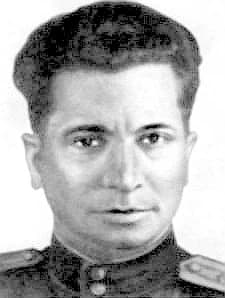
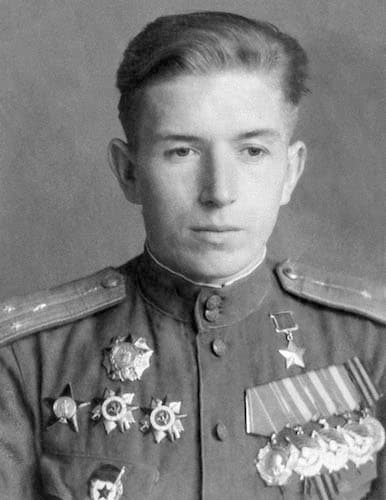
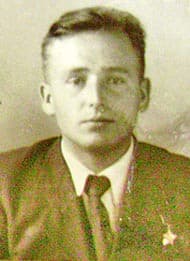
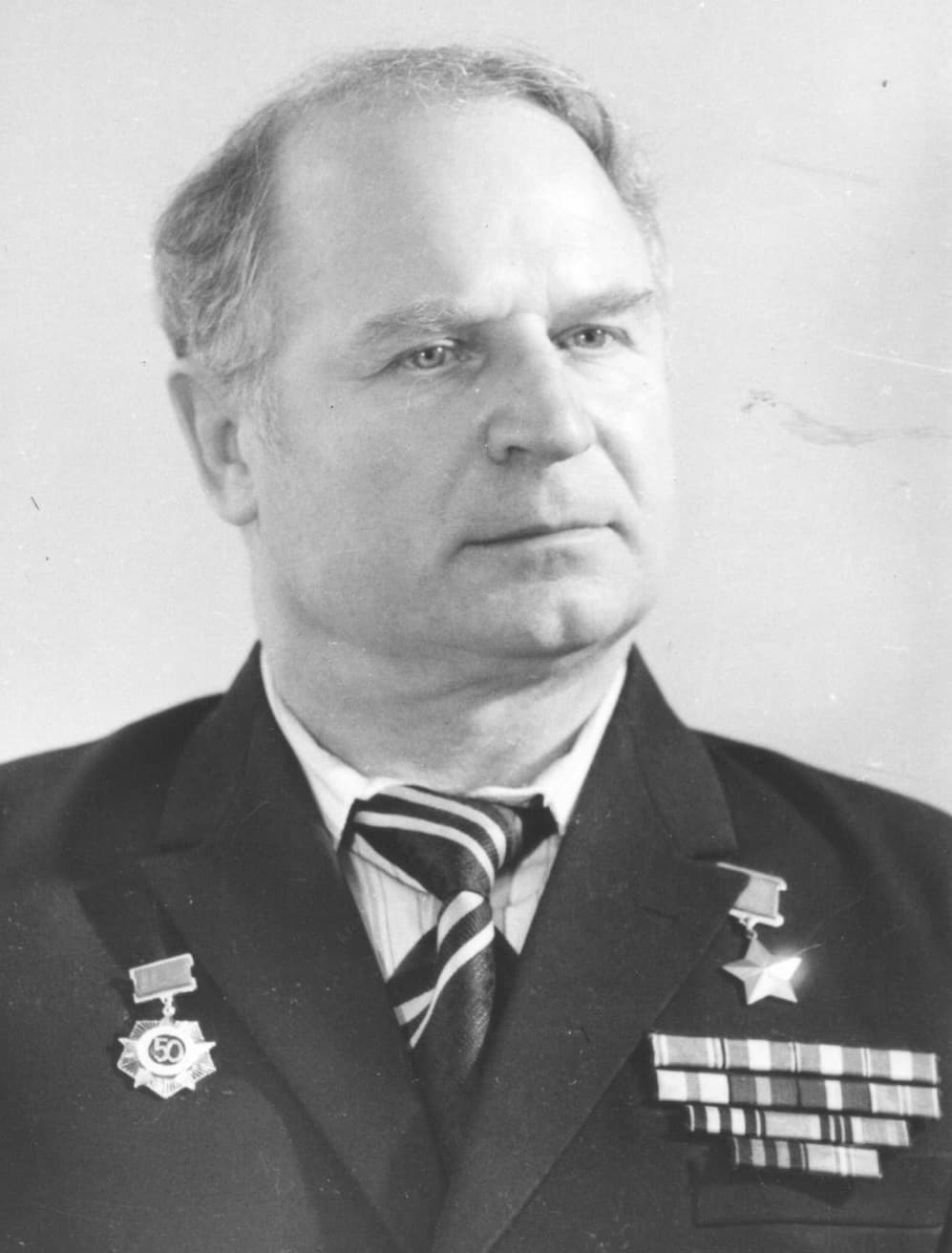
Aleksandr Vasilyevich Belyakov, 1970 — Source: Ministry of Defence encyclopaedia of Heroes of the Soviet Union, encyclopedia.mil.ru. Author unknown. Licensed CC BY 4.0 (Mil.ru).
Biography
Aleksandr Vasilyevich Belyakov was born in 1897 in the village of Bezzubovo, now in the Orekhovo-Zuyevo urban district of Moscow region, the son of a teacher. He spent his childhood and youth in the places where his father worked. He finished the Subbotino rural primary school in 1907, then the Ryazan gymnasium in 1915, and studied at the Petrograd forestry institute in 1915-16.
He was conscripted into the Imperial Russian Army in October 1916, completed the accelerated course of the Alexander military school in Moscow in 1917 and was posted as a junior company officer to the 215th reserve infantry regiment. From July 1917 he fought in the First World War with the 4th Caucasian Rifle Regiment on the Western Front, as a junior officer and head of the regiment's sapper team. After the October Revolution the soldiers elected him to the regimental soldiers' committee. In early 1918 Ensign Belyakov was demobilised.
From February 1919 he served in the Red Army and fought in the civil war. In May 1919 he was sent to Vasily Chapayev's 25th Rifle Division on the Eastern Front — which is why Valery Chkalov later nicknamed him "Chapai" — where he was in charge of anti-gas defence and served as adjutant of an artillery battalion, fighting against Admiral Kolchak's forces and General Tolstov's Ural Army. In January 1920 he was hospitalised at Novouzensk with typhus.
In 1921 he completed the Moscow aerial photogrammetry school and was kept on there: laboratory technician, from 1923 head of the air navigation section, from 1924 chief of the air navigation course. In 1924, without leaving the service, he also graduated from the Moscow forestry institute. From 1925 he flew extensively as an air observer, and in 1929 made his first long-distance flight. From 1930 he taught air navigation, and from April 1935 headed the navigation department of the Zhukovsky Air Force academy.
On 20-22 July 1936, aboard the ANT-25, he was navigator to the crew of Valery Chkalov and Georgy Baidukov on the record non-stop flight from Moscow to Udd island, now Chkalov island, across the Arctic Ocean, a distance of 9,374 kilometres. For that flight he was made a Hero of the Soviet Union on 24 July 1936 with the Order of Lenin. The title was therefore conferred for the flight and not for the war; he is in this archive as a participant in the Great Patriotic War, which is a separate fact.
On 18-20 June 1937 the same crew, again on the ANT-25, made the first non-stop flight in the world from Moscow over the North Pole to Vancouver, 8,504 kilometres.
From February 1936 he was flag navigator of the Special Purpose Army, from January 1939 flag navigator of the Red Army Air Force, and from November 1939 head of a department on the Air Force staff. He took part in the Soviet-Finnish war. From April 1940 he was deputy head of the Air Force academy, and from September 1940 head of the 1st Ryazan higher school for air force navigators.
His war was the training of those who flew. He continued to run the Ryazan school, and in March 1942 took charge of the Higher School for Navigators and Pilots of Long-Range Aviation created on its basis, which worked in evacuation at Karshi and from April 1943 at Troitsk. From 1944 he headed the 1st Ryazan higher officers' school for night crews of long-range aviation. Over the war years the school trained 307 night crews and more than 800 air navigators.
In 1945 he was twice sent to the field army for operational experience: from February to March as deputy commander of the 2nd Air Army on the 1st Ukrainian Front, and from April to May as chief navigator of the 16th Air Army on the 1st Belorussian Front, taking part in the Lower Silesian, Upper Silesian and Berlin operations.
From June 1945 he headed the navigation faculty of the Air Force academy at Monino. He was a doctor of geographical sciences (1938) and a professor (1960), and chief editor of the three-volume Course of Air Navigation (1959-60). In 1955 he took part in the Sever-7 Arctic air expedition, making four long flights on a Tu-4. He retired in August 1960. From January 1961 he was vice-rector for research and teaching at the Moscow Institute of Physics and Technology, from September 1961 head of its military department, and from March 1969 until the end of his life a professor there. He was a deputy of the first Supreme Soviet of the USSR.
He lived in Moscow and is buried at Novodevichy cemetery.