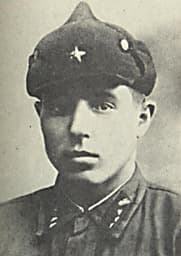
Biography
Semyon Ilyich Bogdanov was born on 29 August (10 September) 1894 in St Petersburg, the son of a Putilov works labourer who had come to the city from Pskov province. Poverty meant he finished only the parish primary school, and he passed the six-year secondary examinations externally as late as 1916. He began work at twelve, as an apprentice fitter at a brass foundry and then in a machine shop, from 1908 as a fitter at the Putilov works, and from 1914 at the Becker and Co. works in Reval.
In January 1915 he joined the Imperial Russian Army of his own accord, as a volunteer, and served as a driver in a reserve aeronautical battalion of the Northern Front's 1st aviation park. In May 1917 he completed the ensign school at Gatchina and became a platoon commander in a reserve infantry regiment; at the end of that year the soldiers elected him to the regimental committee. His last rank in the Russian army was second lieutenant. He took part in the events of the October Revolution and in suppressing an armed rising at Kuopio in December 1917, and was demobilised in February 1918.
He joined the Red Army in January 1918. From January 1920 he fought with the 502nd Rifle Regiment on the Western Front as a company and then battalion commander, took part in the Soviet-Polish war and was severely wounded in June 1920. For his courage — he had been wounded twice — he received his first Order of the Red Banner in 1920. In the spring and summer of 1921, with a composite cadet detachment, he took part in suppressing the Tambov uprising. Two of his brothers were killed in the civil war.
Between the wars he held infantry command posts, graduated from the higher military-pedagogical school in 1923 and from the Vystrel course in 1930. The turn came in May 1932: the 45th Rifle Division was reorganised as a mechanised corps and Bogdanov took over the 134th Mechanised Brigade with its BT tanks. That was how he came into the armoured forces. From October 1935 he commanded the training mechanised regiment at the Academy of Mechanisation and Motorisation, and in January 1938 was appointed to command the 9th Mechanised Brigade.
On 1 May 1938 Colonel Bogdanov was arrested by the NKVD and charged with counter-revolutionary crimes under two points of Article 58, and dismissed from the army. By the sentence of the Military Collegium of the Supreme Court of 27 October 1939 he was acquitted under Article 58 but sentenced to two years for official negligence — and released at once under an amnesty. He was fully rehabilitated on that sentence by the Supreme Court of the USSR in 1968, posthumously. He was reinstated in the Red Army in December 1939 but received no appointment for several months. From March 1941 he commanded the 30th Tank Division at Pruzhany.
That is where 22 June 1941 found him. The division fought in the Bialystok-Minsk and Vitebsk defensive battles and by mid-July had lost all its tanks and suffered heavy losses in men, as did almost every unit that met the war in Belorussia. From July 1941 he was deputy commander of the 5th Army on the South-Western Front; two months later the army was destroyed in the Kyiv catastrophe, and Bogdanov broke out of the encirclement. From October 1941 he commanded the Mozhaysk fortified region and fought in the battle of Moscow.
In May 1942 he formed the 12th Tank Corps and took it into action near Kozelsk in August. In early September 1942 he was removed from command on an unfounded accusation of cowardice and appointed head of a tank camp — and was returned to the front almost at once. From September 1942 he commanded the 6th Mechanised Corps of the 2nd Guards Army and proved himself in the Kotelnikovo operations at Stalingrad; for that fighting the corps became the 5th Guards Mechanised Corps. In the same year, 1942, his conviction was lifted.
From March 1943 he commanded the 9th Tank Corps, which went into action on 8 July 1943 at Kursk, and from September 1943 until the end of the war the 2nd Tank Army, made Guards in November 1944. The army attacked with the 1st and 2nd Ukrainian and the 1st Belorussian Fronts: the Chernigov-Pripyat, Korsun-Shevchenkovsky, Uman-Botosani, Lublin-Brest, Vistula-Oder, East Pomeranian and Berlin operations.
He was made a Hero of the Soviet Union on 11 March 1944 for his handling of the tank army in breaking through the enemy defences on the Uman axis. On 23 July 1944 near Lublin he was severely wounded — a bullet through the shoulder that destroyed the joint — and spent five months in hospital; returning to duty in the first days of January 1945, he led the army in the operation that began days later. He received a second Gold Star on 6 April 1945, for the encirclement and destruction of the Warsaw group, the crossing of the Netze and the Oder and the advance to the Baltic coast. On 1 June 1945 he was made a Marshal of Armoured Forces.
The war took his family. His son by his first marriage, Guards Starshina Rostislav Semyonovich Bogdanov (1921-1943), was an air gunner and radio operator in the 48th Guards long-range reconnaissance aviation regiment and was killed on a combat sortie near Valuyki on 9 March 1943; he was awarded the Medal for Battle Merit for sixteen reconnaissance sorties twelve days later. Three of Bogdanov's brothers and his sister were also killed at the front — which, with the two brothers lost in the civil war, makes six brothers and a sister.
After the war he commanded the army until May 1947 and headed the Soviet military administration in Brandenburg, then commanded the armoured and mechanised forces of the group of Soviet forces in Germany, becoming first deputy commander of the Soviet Army's armoured and mechanised forces in August 1947 and their commander in December 1948. In April 1953 he was appointed to command the 7th Mechanised Army, and from May 1954 headed the Military Academy of Armoured Forces. He retired in May 1956 at his own request on health grounds. He was a candidate member of the Central Committee from 1952 to 1956 and a deputy of the second to fourth Supreme Soviets of the USSR.
He died on 12 March 1960 in Moscow of a stroke and is buried at Novodevichy cemetery.