Biography
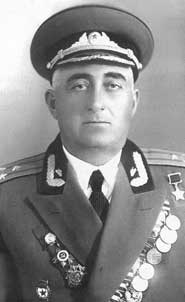
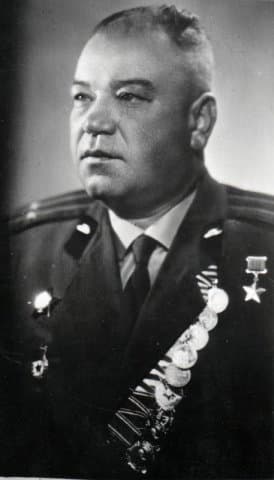
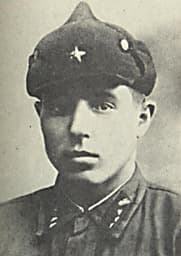
Kharun Umarovich Bogatyryov was born on 15 September 1907 in the aul of Dzheguta in Kuban region, now Ust-Dzhegutinsky district of Karachay-Cherkessia, into a peasant family. He was Karachay. He finished primary school and worked for hire, completed the Soviet party school at Batalpashinsk in 1925, spent two years running the reading hut in his home aul, and from 1927 to 1931 studied at the workers' faculty in Ivanovo.
He was called into the Red Army in 1931, graduated with distinction from the Oryol armoured school in 1932 and was posted as a tank platoon commander to the training mechanised regiment of the Armoured Forces Academy in Moscow, where he became a tank company commander. He completed a command refresher course in 1935 and from 1938 to 1941 served while studying at the academy's evening department. He took part in the Red Square parade every year.
When the war began Captain Bogatyryov asked to be sent to the front, but was appointed deputy battalion commander at the Kazan tank school. He reached the field army only in October 1942, as commander of the 1st tank battalion of the 97th Tank Brigade in the 3rd Tank Army. In January and February 1943 the battalion distinguished itself in the fighting for Rossosh and then for Kharkov. In July and August 1943, in the battle of Kursk, his battalion destroyed a large quantity of enemy force and the battalion commander himself knocked out six heavy tanks. While the brigade commander was ill, Bogatyryov commanded the whole 97th Tank Brigade. He was wounded twice at Kursk and each time returned to duty, finishing his treatment at the front.
By the middle of September 1943 the army had reached the Dnieper, and the 51st Guards Tank Brigade, of which he was deputy commander, took Pereyaslav. On 22 September Bogatyryov led the brigade's motor rifle battalion across the Dnieper in boats near the village of Grigorovka in Kanev district. A surprise attack drove the enemy out of the village and the men held the ground they had taken. Their action made possible the bridgehead that entered history as the Bukrin bridgehead and secured the crossing of the brigade's main force. He was recommended for the Hero of the Soviet Union for this action.
While the papers went through the channels the fighting went on. In the first days of November, in the advance on Kyiv, Bogatyryov took over the 52nd Guards Tank Brigade in place of its wounded commander. On the night of 5 November the brigade under his command destroyed an enemy armoured force on the western outskirts of Kyiv and entered the city; by morning the city was liberated and the brigade pushed on towards Zhitomir in pursuit. For this fighting the commander of the 3rd Tank Army, General Pavel Rybalko, recommended him for the Hero of the Soviet Union a second time — and that recommendation remained on paper.
The source itself names the reason: his nationality. The undisputed facts and their dates are these. On 3 November 1943 — in the days when Bogatyryov was fighting on the approaches to Kyiv — the deportation of the Karachay people began; his family was taken to Kyrgyzstan, to the settlement of Kant. The second recommendation was not acted upon. The first, for the Dnieper crossing, passed through every stage and was signed, which the source explains either by someone's oversight or by the fact that it had been drawn up back in September and October. The causal explanation belongs to the source and is given as its statement; the facts and dates are set out separately.
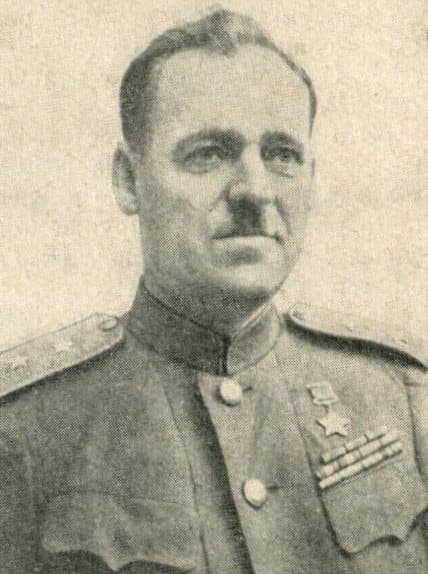
By decree of the Presidium of the Supreme Soviet of 17 November 1943, Guards Major Kharun Umarovich Bogatyryov was made a Hero of the Soviet Union with the Order of Lenin and Gold Star no. 2079, for the crossing of the Dnieper.
In the summer of 1944 he fought at Ternopol and was severely wounded in the advance on Lvov but stayed in the ranks. Soon afterwards, as a member of a deported people, he was recalled from the front to the disposal of the General Staff. The commander of the armoured and mechanised forces, Marshal Yakov Fedorenko, permitted him to continue serving after treatment, and in April 1945 Bogatyryov returned to his army. As deputy commander of the 52nd Guards Tank Brigade, a guards lieutenant colonel, he fought in the taking of Berlin and Prague.
He stayed in the army after the war: in Germany until the end of 1946, then from 1947 to 1951 head of a course at the Armoured Academy in Moscow, where he was promoted guards colonel, and from 1952 to 1954 first deputy head of the Tashkent tank school. He retired in 1954 because of heart disease. He lived in Leningrad and later in Karachayevsk. After several heart attacks he died on 10 July 1966 and is buried in Karachayevsk by the House of Soviets.
He was the first Hero of the Soviet Union among the Karachay people and an honorary citizen of Pardubice, Leningrad and Karachayevsk. A school, a street and a park in Karachayevsk carry his name, as do a school in the aul of Staraya Dzheguta and streets in Ust-Dzheguta, Kyzyl-Oktyabrsky, Sary-Tyuz and Kumysh. Monuments stand to him in Ust-Dzheguta and Karachayevsk, and a bust on the Avenue of Heroes in Cherkessk.