On 8 May 1945, the guns fell silent across Europe. After five years and eight months of total war, Nazi Germany had surrendered unconditionally, and the conflict that had cost over 60 million lives was finally over in Europe.
In Britain, the news triggered the greatest spontaneous celebration the nation had ever seen. King George VI and Queen Elizabeth appeared on the balcony of Buckingham Palace eight times that day, joined by Prime Minister Winston Churchill and the young princesses Elizabeth and Margaret. Over a million people packed the Mall and surrounding streets, singing, dancing, and embracing strangers.
Celebrations Across the Country
In London, the crowds were so dense that traffic came to a standstill. Trafalgar Square, Piccadilly Circus, and the Strand were seas of people. Bonfires were lit in parks and on bomb sites — the very places where death and destruction had rained down for five years. The blackout curtains came down for the last time, and buildings were floodlit for the first time since 1939.
In Glasgow, George Square was packed with tens of thousands celebrating. Edinburgh's Princes Street was a river of jubilant Scots. Manchester's Albert Square, Birmingham's Victoria Square, Cardiff's City Hall — every major city had its moment of collective joy.
Amid the Joy, Remembrance
But VE Day was also a day of profound sadness. Over 383,000 British military personnel had died, along with approximately 67,000 civilians. Thousands more remained prisoners of war in Japanese camps, and the war in the Far East was far from over. Many families celebrated with empty chairs at the table.
Churchill himself, in his broadcast to the nation, reminded the country that 'we may allow ourselves a brief period of rejoicing, but let us not forget for a moment the toil and efforts that lie ahead.' Japan would not surrender for another three months.
The Immortal Regiment Tradition
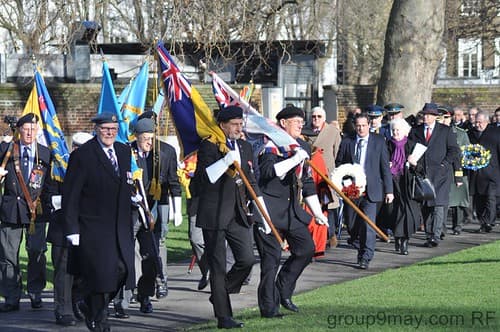
Today, the spirit of VE Day lives on in the Immortal Regiment march on 9 May — Victory Day as celebrated in Russia and many former Soviet nations. On this day, people carry portraits of their relatives who served in the war, ensuring that the faces behind the statistics are never forgotten. In the UK, the Immortal Regiment march unites British and Russian-speaking communities in shared remembrance of the victory over fascism.
How to cite this document
Related Documents
Have archival materials?
If you have documents, photographs, or letters from the war years, consider contributing them to our historical archive.